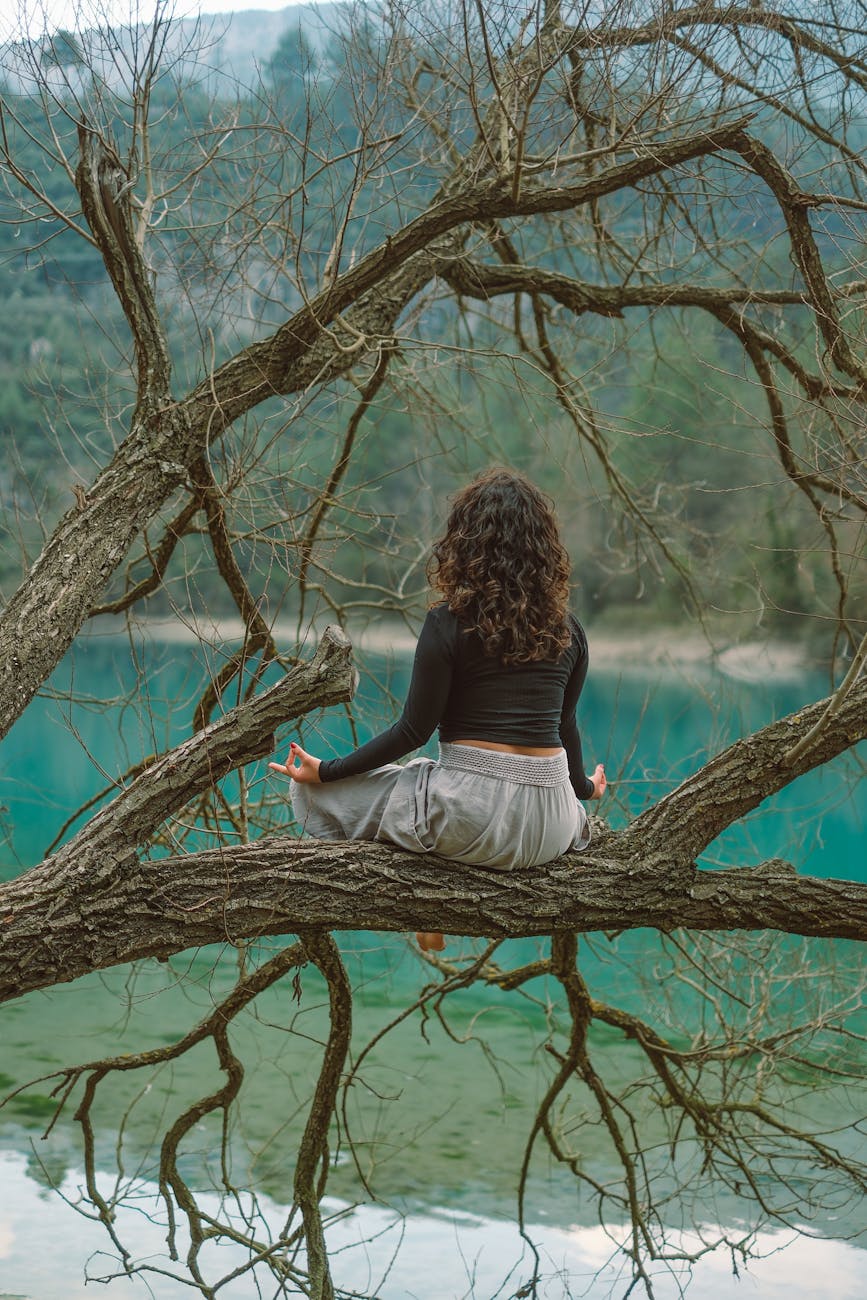
MY TAKE ON HOW YOGA HELPS STRESS & ANXIETY. 9 WAYS THAT YOGA HELPS STRESS & ANXIETY.
I know that yoga helps to reduce my stress and anxiety. This is why I have created a six week online yoga for anxiety course. I have created a bespoke course made up of all the wonderful aspects of yoga that have helped me over the years.
I’ve often wondered exactly what it is about yoga that reduces stress and anxiety. In this blog post, I will pull apart the nine ways in which yoga has helped me specifically with anxiety. From finding meaning and connection, to mastering my breath -read on to find out more.
1/ Finding meaning
There’s a link between high levels of stress and anxiety and lack of purpose or meaning in our lives. Well-being and health podcaster and writer Rich Roll, a former endurance athlete, talks convincingly on podcasts about the correlation between the two. About how finding purpose and meaning in our lives can contribute to reducing stress and anxiety.
Through yoga, we can also find meaning. It may not be something we strive for on the mat, but it can be a happy result of a regular practice. In fact, in yogic teachings and Hinduism, there’s even a word for it – Dharma. You can think of Dharma as your purpose or meaning. Dharma is found when your actions and behaviors are in line with order and custom.
Through practicing yoga, and perhaps self reflection with journaling, it is possible to find a bit more meaning. For this reason, my six week online yoga for anxiety course prioritizes self-reflection after each session.
2/ Finding connection
The link between “connection” and stress reduction is well documented. Connecting with other human beings, even a small but pleasant exchange can cultivate positive feelings.
Yoga helps us to connect in a few different ways. Firstly, attending a yoga class can help us to meet new people. As we move on the mat alongside others, there is a feeling of connection between us. This feeling can sometimes also come from an online class, where we follow along with a teacher and connect with them.
Looking back to one of the oldest teachings on Yoga, ‘The Eight Limbs of Yoga’ by Patanjali. In this text, Patanjali sets out five Niyamas – these are five principles that we should live by as good yogis. One of which is Isvara Pranidhana – which means surrender to the higher power. I interpret this niyama as a reminder that we are just one part of the bigger picture – through yoga, we can feel a connection to the wider world beyond our yoga mat.
3/ Encouraging rest
When was the last time you took the chance to rest? And, I don’t mean sleep. Rest is something completely different.
Until the last few years, I really struggled with the concept of rest. In a society which rewards being “busy”, and where a long to do-list is seen as a point of pride, it is very hard to take time to rest. It is especially hard to rest without feeling that ought to be doing something different, more difficult or more productive.
New York Times bestseller, Greg Mckeown has written books about the art of doing less – “the disciplined pursuit of doing less.” I recently heard an interview with Greg, where he said “Burnout is not a badge of honour.” Yet, so many of us heading towards burnout, simply refuse to rest. Even though we know lack of rest creates a downward spiral to stress & anxiety.
Yoga, in particular restorative yoga, creates a space in which it feels safe to rest. Rather than “doing nothing”, instead you can get into a pose that is specifically going to help you to rest, thereby reducing cortisol and corresponding stress & anxiety.
4/ Looking inside rather than out
James Nestor, the author of ‘Breath. The new science of lost art,” has spoken in interviews about how as a society we have become reliant on seeking the answer from outside, rather than looking in.
If we want to solve a problem, we will google it, or ask someone. Yet, when it comes to relieving symptoms of stress and anxiety, we cannot look outside ourselves – we need to look within.
Nestor argues that when we are suffering with symptoms of stress and anxiety, we may not actually have a disorder. Instead, we may be having a reaction to too much external stimului. Instead, if we focus on slowing our breath and reducing external stimuli, we can in turn reduce symptoms of anxiety and stress.
So, if that is true, then yoga and in particular the “pranyama” aspects of yoga which teach the art of breath-work, can relieve the symptoms of anxiety and stress. Yoga also teaches us to find tools within ourselves, using our own bodies, rather than looking outside for validation.
5/ Learning to let go of what we cannot control
Personally, I know that one of the biggest triggers for my anxiety is feeling overwhelmed. Yet, when I breakdown the things that I am overwhelmed by, I realize that I am not actually in control of much of it. To reduce anxiety and stress, we have to learn to let go of what we cannot control.
Through yoga, on the mat, we learn that some poses work for us and our bodies, and others don’t. Sure, there are many poses that we can improve over time, but there will be poses that are just not as natural for our bodies. We learn to let go of what we cannot control.
Through meditation practice, we also learn to notice thoughts as they come up, but let them go. It’s like doing a practice drill for handling real life situations. Even ten minutes of meditation per day will help us to let go of what we cannot control.
6/ Disconnect from technology
As a society, we have become completely accustomed to being connected all the time through our technology. There is less separation between work and life, we are almost always “on call” in one way or another. And, as time goes by, fewer and fewer people know what it’s like not to be plugged into the internet all the time.
There’s a school of thought linking high levels of stress and anxiety in society, with high levels of “connection,” through technology. If we don’t spend enough time disconnected, our bodies are in a constant state of fight of flight. If you think about every “ping” on your phone, every email, or Whatsapp notification as a teeny tiny stress creator, the cumulative effect of all of these could be huge.
One thing I love about walking into a yoga studio, or rolling out my mat in a quiet space, is that as soon as I do this I know my phone is not going to bother me during my practice. Yoga can help to reduce anxiety purely by giving you space and time away from your phone.
7/ Accepting emotional and physical discomfort
There are a number of really important concepts in yoga practice that can help us to accept discomfort. Specifically, the Buddhist teaching of “Samsara”, – the idea that everything is always changing, it is impermanent.
When we are on our yoga mat, we might experience emotional or psychical discomfort – remembering that this is impermanent, can sometimes help us to gain perspective. And, if we can’t realise this in the moment (which I often can’t), once the pose or class is finished, we are soon reminded!
And how does this help with anxiety or stress? Often anxiety or stress feels permanent. I know when I have had high anxiety, it can feel that I may never find a place of calm again. Yoga reminds us that this is not true. And, in remembering that everything is impermanent, we can accept emotional and physical discomfort for what it is – temporary.
8/ Breathing as an anchor to gain physiological control
Established science shows us that our breath impacts our physiology. Slowing down the breath triggers physiological impacts, which lower cortisol. As high cortisol is associated with anxiety, lowering it can help to reduce anxiety.
We only have to look at the opposite of this to see what he means – if we breath in and out quickly and sharply (as if hyperventilating), our fear responses become immediately heightened.
The best breathing exercises for stress and anxiety prioritize slow, steady breath, often with a short breath retention. My six week online yoga course for anxiety introduces six different breathing exercises that can help to reduce the symptoms of stress and anxiety.
9/ Movement can combat stress
Psychologist Kelly McGonigal, the author of ‘The Joy of Movement,” is a proponent of how movement can combat stress. McGonigal points to how exercise and movement can produce short term changes to brain chemistry – we feel better after exercising. But also that longer term, regular exercise can change the way that our brain reacts to stress by becoming more resilient to it.
New research indicates that when we move our muscles, they can create “myokines” which have a strong and positive effect on our brains.
So, every time we move, whether on the mat through yoga, or taking a walk, our muscles are creating myokines. These are making our body healthy, but also improving how our brain reacts to stress.
My yoga for anxiety course prioritizes movement for this reason. The first week of the six week course is all about starting to move your body again, as a way to reduce anxiety through yoga. If you’re interested in this course, you can find out more information and enroll here.
Please note that some links on my website are partnered with affiliates. Using an affiliate link does not make it more expensive for you to purchase. We receive a small commission whenever you buy something which in turn allows me to keep writing independent content. Your support is greatly appreciated.
I participate in the Amazon Services LLC Associates Program, an affiliate advertising program designed to provide a means for sites to earn advertising fees by advertising and linking to Amazon.com. As an Amazon Associate, I earn from qualifying purchases.
 Game Changer Yoga
Leave a comment